

Manual dispatching problems are expensive in a way that never shows up on an invoice. Nobody bills you for the forty minutes your dispatcher spent rebuilding Tuesday morning, or for the extra kilometres a tech drove because the board put two jobs in the wrong order. The money leaves anyway — payroll, fuel, and the calls you did not get to.
That is what makes a whiteboard feel free. It is already paid for. Robin Cooper and Robert Kaplan made this argument about factories almost forty years ago in Measure Costs Right: Make the Right Decisions (Harvard Business Review, September 1988): when a real cost has no line of its own, it gets buried in overhead, and managers make confident decisions on numbers that are quietly wrong. A dispatch board is the same problem with trucks.
Almost every cost below resolves into hours or kilometres, so price both before you start.
An hour of technician time. The median wage for HVAC mechanics in Ontario is $37.00 an hour (Job Bank, from the Statistics Canada Labour Force Survey, 2023–2024 reference period, updated 7 August 2026). That is the wage, not what the hour costs you: CPP, EI, WSIB, vacation pay and benefits sit on top. Statistics Canada does not publish a burden share in a form you can just multiply by, so use your own payroll — your last remittance is a better number than anything on this page.
A kilometre of truck. The tax-exempt automobile allowance rate for 2026 is 73 cents per kilometre for the first 5,000 km and 67 cents after that, effective 1 January 2026 and set each year by the Department of Finance (announced 14 January 2026; 77 and 71 cents in the territories). Not a perfect proxy for a loaded service van, but published and dated.
Running trucks in the United States? The equivalents are 72.5 cents per mile (IRS business standard mileage rate, 2026) and about $42 a loaded hour — a $29.33 median wage over a 70.0% wages share of compensation cost, both Bureau of Labor Statistics.
What follows has no per-truck dollar range attached to each item. We went looking for time-and-motion research on dispatcher hours and technician drive time, and every figure we could reach traced back to a software vendor's blog with no study behind it. Quoting them would make your business case weaker. Method instead of benchmark.
Some of these will not apply to you. If your techs are all cross-trained, cross out row four. If you already text reminders, cross out row six. A total built from the rows you actually recognise is worth more than a bigger number you have to defend.
There is no download here and no calculator to sign up for. Copy these eleven lines into a spreadsheet, fill in only the rows you recognise, and total the column.
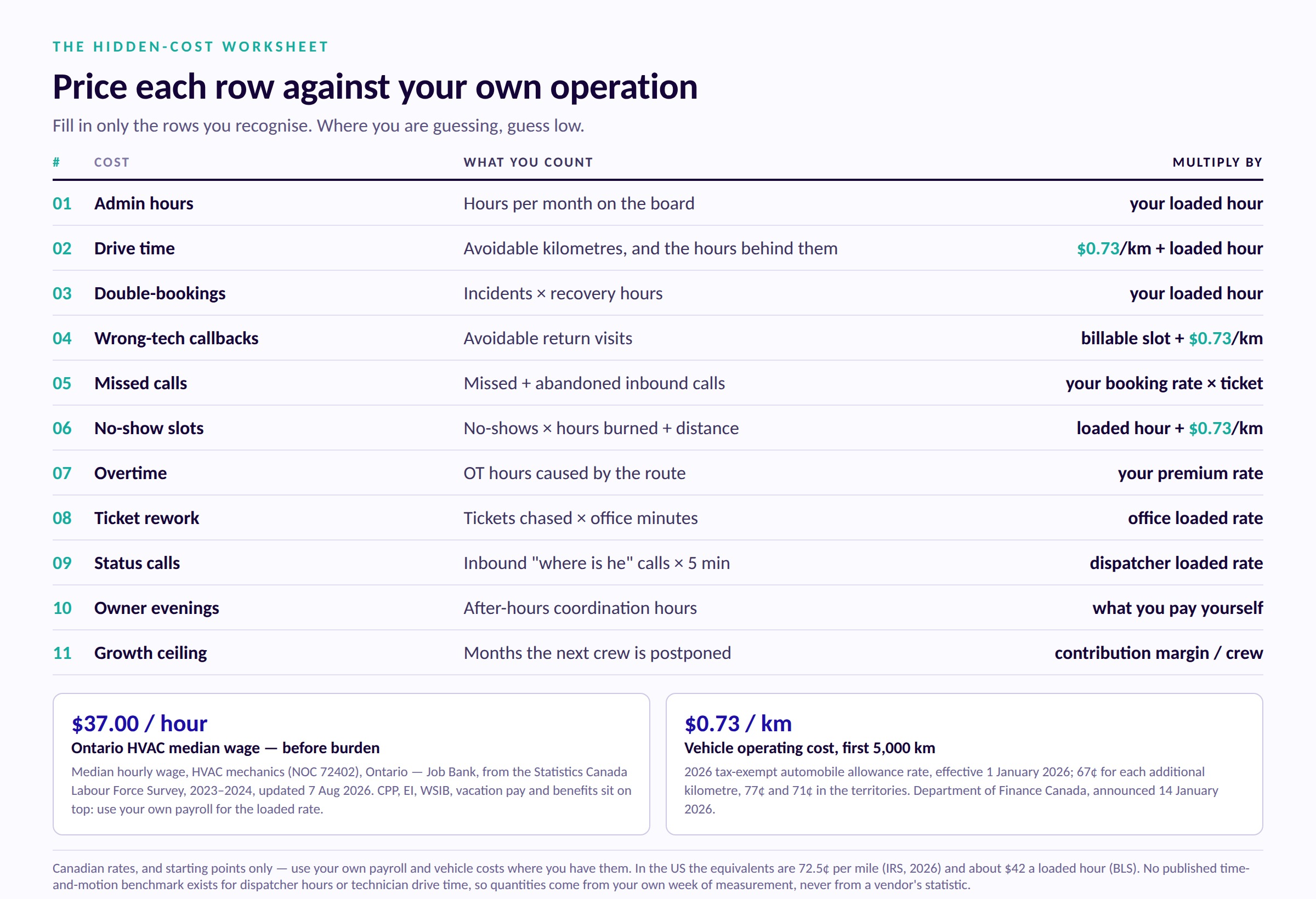
Two rules keep the total honest. Count a cost once, in the row where it belongs. Where you are guessing, guess low and write the guess in the next cell.
For most shops under fifteen trucks, rows one, two and five carry the weight: admin hours, drive time and missed calls. They are also the three that respond fastest, because each is a scheduling decision rather than a habit.
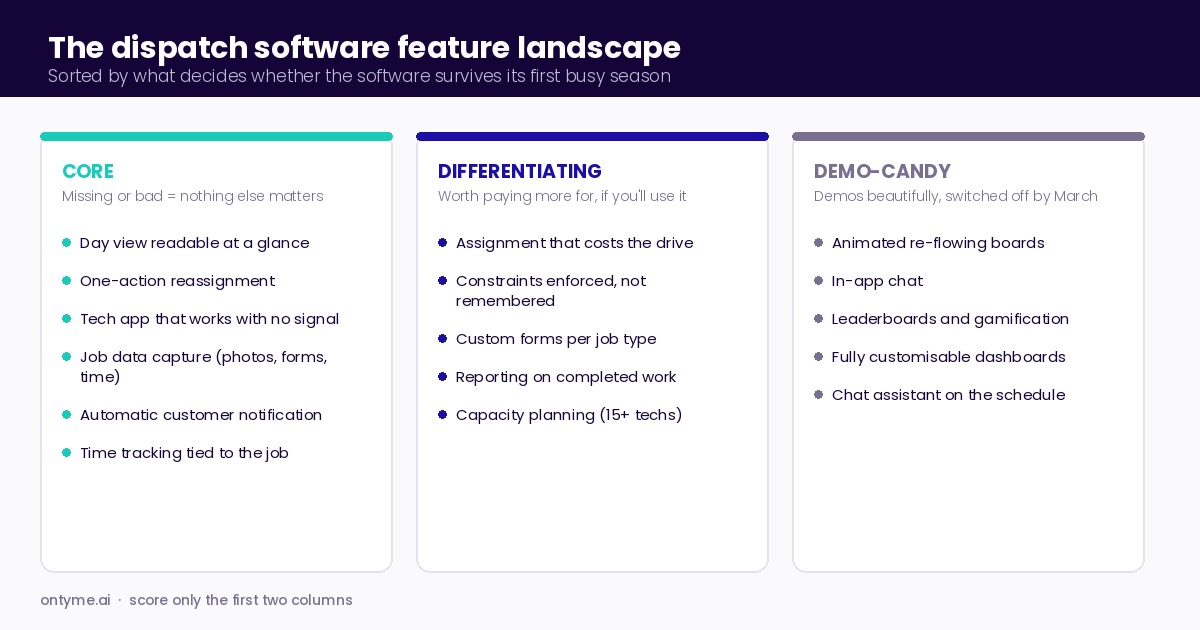
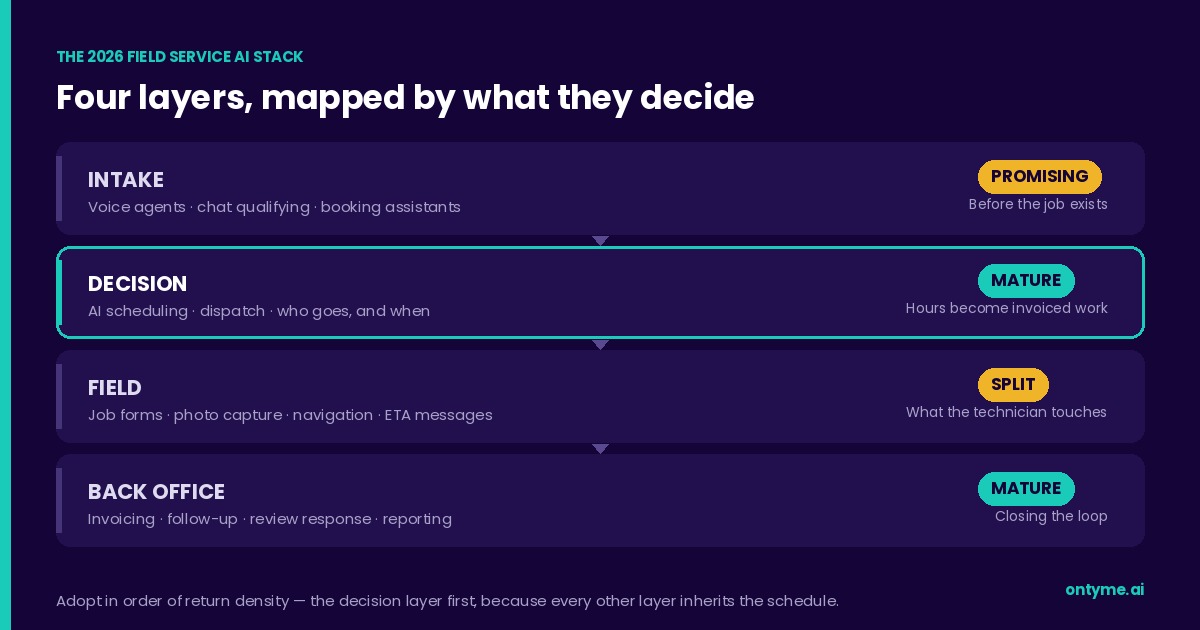
It is worth knowing what a scheduler does and does not touch. OnTyme's recommendation takes the installers you name, checks each against the hard rules — on the roster, not on approved vacation, not inside a statutory or company holiday, inside company working hours, not already booked — then walks every 30-minute mark in that day's open gaps and returns the single slot with the lowest total travel time, using traffic-aware drive times. Each suggestion arrives with a plain sentence naming the gap it found and the travel arithmetic behind it, and a person decides whether to take it. That is rows one and two.
What it does not do is re-order a day that is already booked. Travel time is minimised when a job is placed; the sequence of an existing day is left alone. If your day is full and out of order, that is a dispatcher's job, and any vendor who says otherwise should demonstrate it on your board. How the constraints and the travel-time objective work goes through it in detail.
Row five is not a scheduling problem. It improves the moment the person holding the board stops also holding the phone.
Once the column has a total, the temptation is to set it against a price. OnTyme's Standard plan is $50 a month for ten team members, additional users $5 a month, with a 30-day trial (ontyme.ai/pricing, 19 September 2026).
Resist it. Software does not collect the whole column. It collects the part of rows one, two, six and nine that better scheduling, appointment reminders and a tech-sent ETA message actually recover, and none of rows three through five on their own. The honest question is not whether $50 beats your total — it is which rows you will really claw back, and whether that subtotal is worth the month it takes to change how your shop books work. The full ROI formula, worked for a six-technician shop takes that apart, including the savings that do not survive scrutiny. If you are still mapping the category, the complete guide to dispatch software covers what the tools do and cost.
Now the bill has line items. If your total made you wince, bring the worksheet to a conversation with us — it is a better first meeting than a feature tour.
There is no credible industry average, and anyone quoting one to two decimal places is selling something. It is the sum of the eleven rows above as they apply to your shop, built from your own hours, kilometres and missed calls, priced at your own loaded hourly rate — the Ontario median HVAC wage is $37.00 before burden (Job Bank / Statistics Canada) — and 73 cents a kilometre (2026 tax-exempt automobile allowance rate, first 5,000 km).
We could not find a defensible published figure, so measure it: for one week, have whoever builds and rebuilds the board note start and stop times on scheduling work only.
Price the recovery, not the error: time spent reshuffling and apologising, any crew time standing still, and the trip that has to happen again. Thirty minutes of loaded time per incident is conservative, and the customer relationship cost sits on top, unpriced.
Nobody publishes a trustworthy number. Measure your own: one week of odometer readings per truck, have someone who knows the territory re-order that week's stops on paper, and count the difference in kilometres and hours. That gap is your figure, and it is the only one you can defend.
When the rows it can actually recover exceed its monthly cost — mostly admin hours, avoidable drive time, no-shows and status calls. Compare that subtotal against the plan price, not your whole worksheet, and give it a month of real use.