Route Optimization for Field Service: How Much Drive Time Can You Actually Cut?
Your tech pulls into the driveway at 6:30 again. Nothing went wrong today. Four jobs, all finished, no callbacks. The day just ran long because the van spent half the afternoon crossing the 401 and back. That is the problem route optimization for field service promises to fix, and most of what gets written about it starts with a percentage nobody can back up.
This article starts with the questions instead: how much of the day is driving, what the size of the cut depends on, when a free maps app is enough, and what recovered drive time turns into once you run the arithmetic honestly.
The Windshield Hours Audit
The most-quoted drive-time figure comes from The Service Council's benchmark of 42 organizations, which put average drive time at 27% of a technician's total workday in 2016 (The Service Council, 2017 Field Service Benchmark: Early Results, TSC Data June 2017).
Read it carefully before you borrow it. The sample skewed large (71% ran 50 or more technicians) and toward medical, facilities, high-tech and telecom service. A six-truck HVAC shop in the GTA lives in a different world. Treat 27% as evidence that drive time is a quarter-of-the-day problem, not as your number.
Your number takes a week to get. For five days, record each tech's first departure, every site arrival and departure, and their final return. Divide the minutes between sites by the minutes between first departure and final return. Whichever way the result surprises you, it is worth knowing before you buy anything.
Then price it, in Canadian figures:
- Labour. The Ontario median wage for an HVAC mechanic is $37.00 an hour (Job Bank, NOC 72402, Statistics Canada Labour Force Survey, 2023–2024, updated 7 August 2026). That is the wage before CPP, EI, WSIB, vacation pay and benefits. Build your loaded rate from your own payroll.
- Fuel. Regular gasoline at self-serve pumps averaged 170.3 cents a litre in Toronto in August 2026 (Statistics Canada, table 18-10-0001-01, released 14 September 2026). Multiply by your van's real litres per 100 kilometres, not the brochure figure.
- The whole vehicle. For an all-in cost per kilometre, the federal tax-exempt automobile allowance is 73 cents a kilometre for the first 5,000 km in the provinces in 2026, 67 cents after that (Department of Finance Canada, announced 14 January 2026). It is a reimbursement rate, not your cost, but a documented stand-in for fuel, wear and depreciation together.
Those are the visible costs. The invisible one is the job that never happened because the slot was spent in traffic. We come back to it at the end.
What Route Optimization Actually Does
Route optimization does two things. Sequencing decides the order a technician visits a set of stops. Clustering decides which stops belong together in one van's day in the first place. Clustering is usually where the bigger savings are: no ordering rescues a day that sends one tech to Oakville and Pickering.
The idea is old. In 1964, G. Clarke and J. W. Wright planned depot deliveries by treating every stop as its own out-and-back trip, then merging the pairs that save the most distance ("Scheduling of Vehicles from a Central Depot to a Number of Delivery Points," Operations Research, Vol. 12, No. 4, 1964, pp. 568–581). Their "savings" logic still explains the intuition: two nearby stops on one loop cost far less than two trips from the shop.
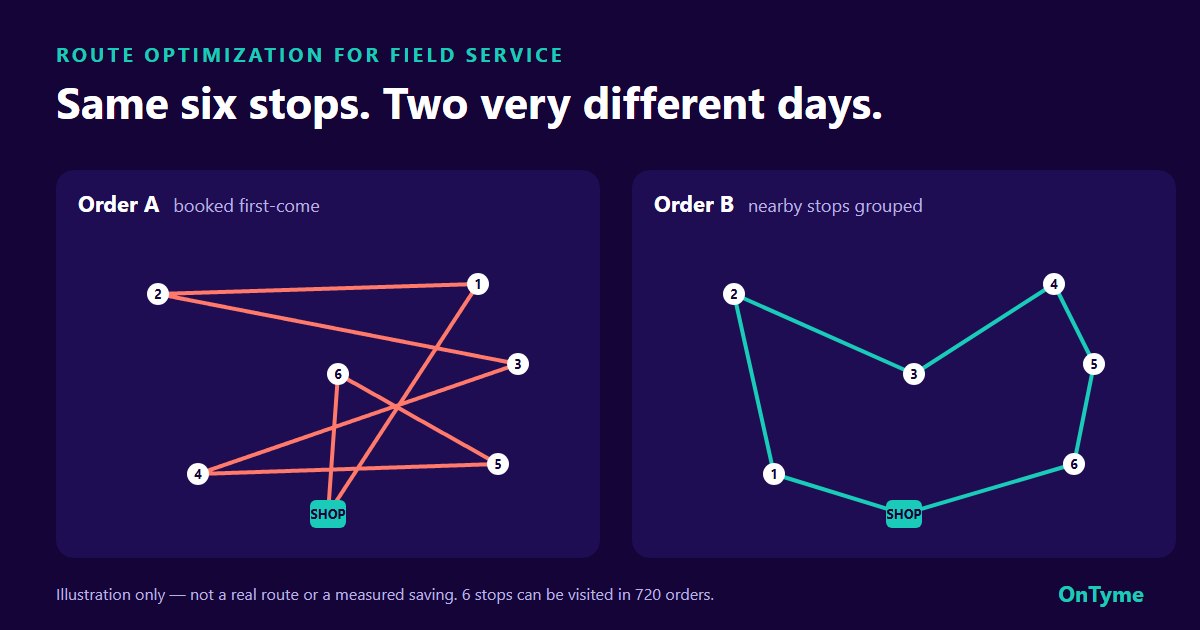
Past a handful of stops, the number of possible orders explodes. Six stops can be visited in 720 different orders. Eight stops: 40,320. Ten: more than 3.6 million. A good dispatcher gets four stops right almost every time. Past six or so, nobody is comparing the options; they are picking one that looks reasonable.
Honest Savings Ranges for Route Optimization in Field Service
There is no neutral, published range for how much drive time route optimization saves a small service fleet. The 20%, 30% and higher figures on vendor pages do not come with a study, a sample or a starting point attached. We looked, and we will not repeat a number we cannot source.
What we can say with confidence is what the size of the saving depends on. Three factors decide most of it:
- Job density. How many stops each tech has in a day, and how close together they are. A tech with two long installs a day has almost nothing to re-order.
- Territory size. A tech covering one city has short legs and small absolute savings. A tech covering the whole GTA and up to Barrie has long legs, and every bad pairing costs real kilometres.
- Window tightness. Every promised arrival time removes orderings from the table. Two-hour windows on every job can leave only a handful of feasible routes.
A fourth factor never makes the sales deck: how good your routing already is. A dispatcher who zones the city and books by area has already captured much of the clustering benefit, so software beats them by less than it beats first-come booking.
You can estimate your own ceiling for free. Take five days from last month and, on a map, re-sequence each tech's stops for the shortest drive, ignoring the promised windows, and add up the difference. That is your upper bound. Then redo it respecting every promised window. The gap between the two is what your windows cost you.
The Time-Window Tension
Customer windows and efficient routes pull in opposite directions. A customer who can only do 8 to 10 in Mississauga and another who can only do 9 to 11 in Scarborough have just fixed a chunk of your morning, and no algorithm can undo that. Researchers treat it as a harder problem in its own right; Marius M. Solomon's 1987 paper set out routing with time windows and the test cases still used to measure solutions ("Algorithms for the Vehicle Routing and Scheduling Problems with Time Window Constraints," Operations Research, Vol. 35, No. 2, 1987, pp. 254–265).
That means the cheapest routing improvement you can make is often a booking policy, not software:
- Sell wider windows by default. An AM or PM band gives you far more ways to order the day than four two-hour windows.
- Keep narrow windows as a premium. Offer them when a customer truly needs one, and price or limit them accordingly.
- Tighten the window on the day itself. A text that says the tech is on the way and when they will arrive turns a wide band into a precise time without locking you into it at booking.
In OnTyme, that last step is a technician action: from Your Day, the tech taps Send ETA & Start Navigation, and the customer gets a text with the expected arrival and whether the tech is running early, late or on time. The technician sends it; a schedule change does not trigger it automatically.
Routing App vs. Scheduling Engine
In fairness to the free option: for many shops, a maps app and a disciplined dispatcher are enough. That holds when you run one to three techs with two to four longer jobs each, book by area, and book days ahead. There, the order of stops is mostly obvious and routing software solves a problem you do not have.
The picture changes when the hard question becomes "who, and when". When several techs could take a new job, calls come in for today, and one day is lopsided while another is half empty, the bigger problem is putting the job into the right van and slot in the first place. That is the difference between route optimization and assignment, and it is the line we drew in the three layers explained.
That is the layer OnTyme works on. When you book a job, the scheduler searches every technician in the pool you select, every date in range and every 30-minute start time. It looks at four kinds of gap: an empty day, the start of a day, the space between two booked jobs, and the end of a day. For each candidate it asks Google's routing service for traffic-aware drive times to the job and away from it, and it recommends the slot with the least total travel. It says why, with the drive times spelled out. How AI scheduling actually works walks through that search in detail, and the routing inside OnTyme is laid out on the product page.
Placing jobs this way does some of the clustering at booking time, because a new job tends to land beside nearby work. What it does not do is re-order a day that is already booked. OnTyme does not sequence a technician's stops. Navigation is a hand-off to Google Maps for each job, and the drive is calculated one leg at a time. If your pain is a dozen short stops per tech that need re-ordering every morning, ask any vendor, us included, to show that workflow on your own data.
One More Job a Day: The Compound Math
"One more job a day" is the promise behind most routing pitches. Here is the arithmetic, with every input labelled.
The illustrative tech: 2 hours of driving and 120 kilometres a day, a van using 14 litres per 100 km, 240 working days a year. Assume better routing and booking cut both by 15%. All of these are assumptions, not benchmarks.
- Time recovered: 18 minutes a day. Over 240 days, that is 72 hours a year.
- Labour value: 72 hours at the $37.00 Ontario median comes to $2,664 a year per tech, before burden.
- Distance recovered: 18 km a day, 4,320 km a year.
- Fuel only: 4,320 km at 14 L/100 km is about 605 litres. At 170.3 cents a litre, that is roughly $1,030 a year.
- All-in vehicle proxy: 4,320 km at the 73-cent allowance rate is about $3,154 a year, the ceiling if you count wear and depreciation as well as fuel.
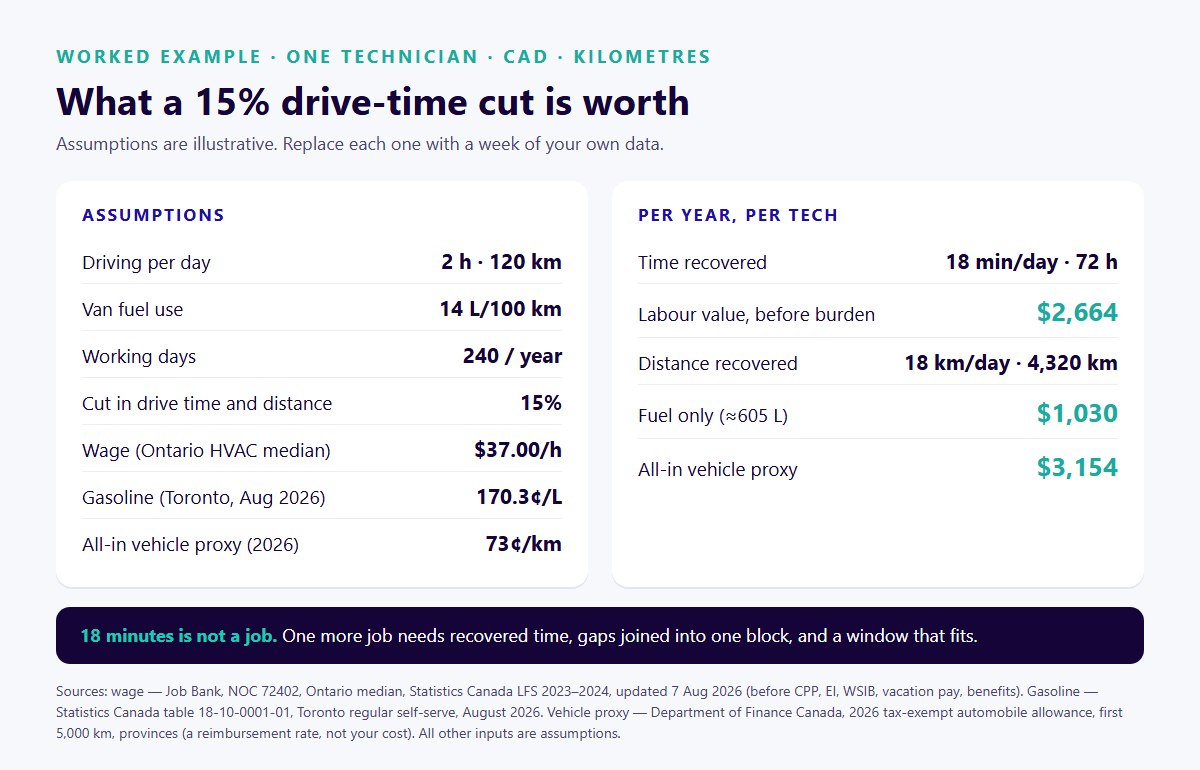
Now the honest part. Eighteen minutes is not a job: a service call plus the drive to it needs an hour and a half or more. What it usually buys is the tech home before 6:30, an overrun absorbed, or less overtime.
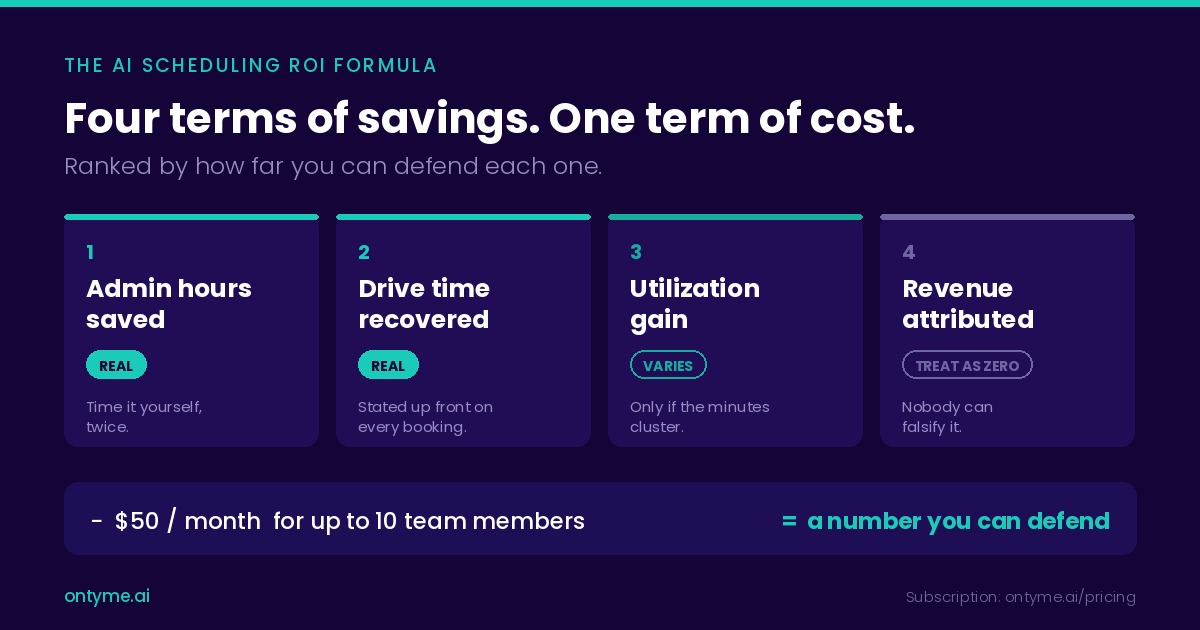
One more job a day takes three things together: enough recovered drive time, gaps consolidated into one usable block rather than scattered 20-minute fragments, and a customer whose window fits that block. That is why booking matters as much as routing. For the full payback formula, including the costs software adds, see the worked ROI formula.
The route is only half the answer. Who drives it, and when, is the other half. See how OnTyme picks the technician and the slot in a demo.
FAQ
How much drive time does route optimization save?
It depends on density, territory, window tightness and how well you route today. No neutral study publishes a range for small fleets, so re-sequence five past days on a map to find your own upper bound.
Do customer time windows ruin route optimization?
They limit it. Every promised window removes possible orders. AM/PM bands plus a same-day ETA text often recover more than software alone.
Is a routing app enough for a service business?
Often, if you run a few techs with a few longer jobs each and book by area. When several techs could take a job and same-day calls are common, who and when matters more than stop order.
How many stops can a tech do per day?
That depends on job length, not routing: two long installs or six short calls can both fill a day. Build it around your own on-site time per job type.
Does route optimization save fuel costs?
Yes, in proportion to the kilometres it removes. At 170.3 cents a litre (Toronto, August 2026), every 100 km cut from a van using 14 L/100 km saves about $24 in fuel. Use your own van's real consumption.