Plumbing Dispatch Software: Emergency Calls, Priority Queues and On-Call Rotation
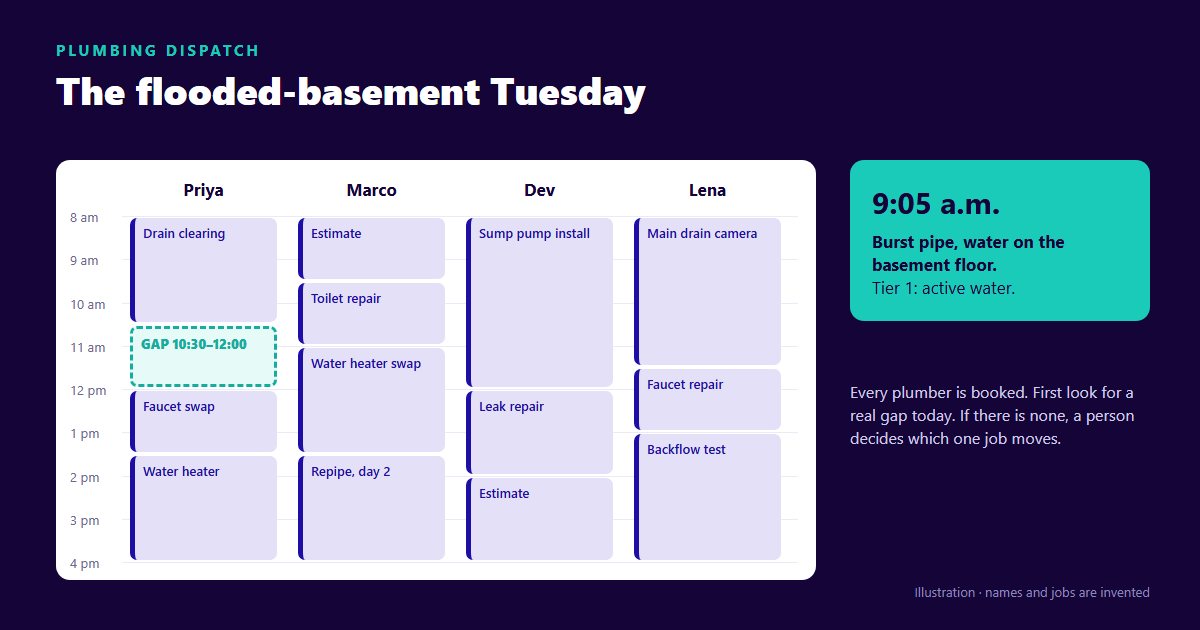
At 9:05 on a Tuesday a homeowner calls: a pipe has let go in the basement and there is water on the floor. Every plumber is booked until four. Plumbing dispatch software earns its keep in the next ten minutes, or it doesn't.
This guide is for plumbing and drain shops of three to twenty trucks. OnTyme is the worked example, including the parts it leaves to you.
The Flooded-Basement Tuesday
The manual version: the dispatcher guesses who is closest, phones them, and finds they are under a sink across town for another hour. Second call, same answer. The third plumber can go, so someone's 11 a.m. water heater swap gets pushed to two, and nobody tells that customer until she rings at 11:20.
Three things went wrong, and only one was the emergency. The dispatcher guessed at location, the choice of which job moved was made in a hurry, and the moved customer found out by waiting. This article takes them in order, then on-call, because the 9 a.m. emergency has a 2 a.m. cousin.
Severity Tiers for Water
Water keeps doing damage while you decide. That is the case for tiers, and for writing them down before the phone rings:
- Active water. Water is coming out and can't be stopped, or is near the electrical panel. Same day, ahead of everything, even if a booked job moves.
- No water or no hot water. A whole house without water, or no hot water with infants or elderly people at home. Same day if a gap exists, first thing tomorrow if not.
- Functional but failing. A slow leak into a bucket, a running toilet, a drain that clears eventually. Next open slot that suits the customer.
- Routine. Fixture swaps, estimate visits, water heater replacements on a working unit. Booked like any planned work.
The intake script
Tiers only hold if intake asks the same questions every time. There is no download; copy this list and put it beside the phone:
- Is water coming out right now? Can you find the main shut-off and close it?
- Is water near the electrical panel, outlets or appliances?
- Do you have water anywhere in the house? Hot water?
- Who is at home: infants, elderly, anyone unwell?
- Is this a house, or a unit with other units below?
The shut-off question does double work. A customer who closes the main valve while you're still on the phone may move from tier 1 to tier 2, and that is the cheapest dispatch decision of the day.
Name the loudest-caller bias
Without a script, priority goes to whoever sounds most upset, which is rarely whoever has the most water. A calm retiree with a soaked ceiling waits while an angry caller with a dripping tap gets the truck. The script gives the dispatcher something to point to.
The Minimal-Disruption Insertion
An emergency lands on a full board in one of two ways: into a gap that already exists, or by moving something. Always look for the gap first.
How OnTyme finds the gap
OnTyme's AI-Powered Scheduling works one job at a time. The dispatcher enters the job address, the expected duration and a date window, and picks which plumbers to consider. For an emergency, set the window to today. The scheduler checks those plumbers' open time in 30-minute steps (between jobs, at either end of the day, and on empty days) and skips anything that overlaps a booking, falls outside company hours, lands on a day off or a holiday, or starts in the past. Drive time comes from Google's traffic-aware routing, from the previous job's address and on to the next.
It recommends the slot with the least total drive time, with a plain-English reason naming the gap and the minutes either side. The mechanics are in how the scheduling engine works.
Know what that objective is. The scheduler minimises drive time, not response time. Within today, it may prefer a 2:30 gap with ten minutes' drive over an 11:00 gap with thirty. For active water, the dispatcher books the earlier gap by hand if speed matters more. That is the human override doing its job.
If no plumber has a long enough gap today, the scheduler reports that no feasible slot was found. It does not move anyone to make room.
When something has to move
Then a person picks which booked job moves. Decide the rule before the day, not during it:
- Move routine work before failing-but-functional work, and never another tier 1.
- Prefer a customer who has said they're flexible, or a job more than two hours out, before they have left work to wait.
- Move one job, not three. The emergency should cost one customer a reschedule, not the whole afternoon.
OnTyme's board shows every plumber's day side by side. On the web you drag the job to its new time; the board checks it against that plumber's other bookings, names any clash and asks you to confirm. OnTyme does not re-solve the day or cascade changes on its own. The full playbook for a day that goes wrong is in the re-dispatch playbook.
If another vendor says its software rebalances the day automatically when an emergency arrives, ask to see it live: a burst pipe added to a full board, which job moves, and who tells that customer.
The Bumped Customer Problem
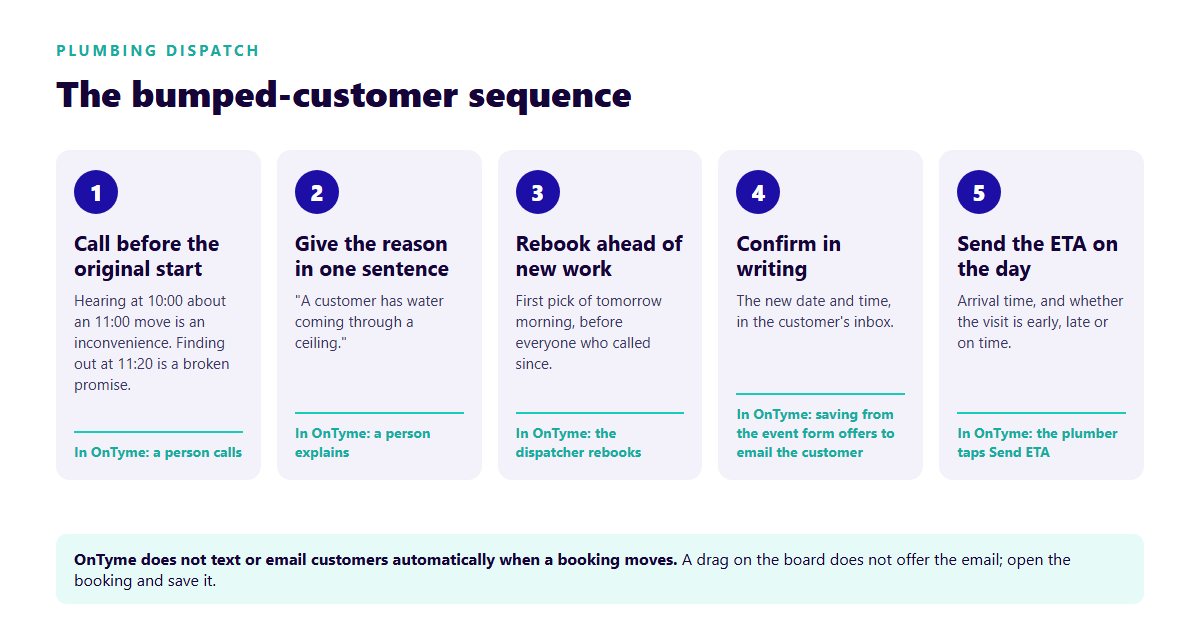
The emergency customer is grateful. The bumped one, who took the morning off, is the one you can lose. What protects them is speed and specifics:
- Call before the original start time. A move they hear about at 10:00 for an 11:00 slot is an inconvenience. One they discover at 11:20 is a broken promise.
- Give the reason in one sentence. "A customer has water coming through a ceiling." Most people accept that from a plumber. Nobody accepts silence.
- Offer the new slot ahead of new bookings. First pick of tomorrow morning, not the next opening after everyone who called since.
- Confirm in writing, and send the arrival time on the day.
A script for step one: "Hi, it's Sam from the office about your 11 o'clock. A burst pipe came in nearby and your plumber is on it. I can do two today or 8 tomorrow morning. Which suits you?"
What OnTyme sends, and what it doesn't
OnTyme does not text or email a customer automatically when a booking moves. The call is a person's, and it should be.
For the written confirmation: when a confirmed booking is saved from the event form, OnTyme asks whether to email the customer and sends their appointment details with the current date and time. A drag on the board does not ask, so after dragging a job, open it and save it to send the email.
On the day, the plumber taps Send ETA in the app. The customer gets a text with the arrival time and whether the visit is early, late or on time, and the plumber's phone opens directions.
On-Call That Doesn't Burn Out the Same Two Guys
The usual on-call failure is not a bad rotation but no written one, so the two people who answer their phones become the rotation. Three models suit small shops:
- Weekly. One plumber holds the phone Monday to Sunday. Simple, but a bad week is very bad.
- Weeknights and weekends split. Fairer when weekend calls run long.
- Primary and backup. The backup takes the call when the primary is already on one, for a smaller standby amount.
Write down who is on, what they're paid for being on and for being called out, and the earliest start they owe the next morning after a night call. A plumber who finished at 3 a.m. should not get the 7:30 install.
The Ontario rules to check
In Ontario, an employee who regularly works more than three hours a day and is required to present for work, but works less than three hours, is owed three hours' wages under the Employment Standards Act, s. 21.2 (Ontario.ca Policy and Interpretation Manual, updated 29 September 2022). How that applies to your call-outs depends on your arrangements, so check with the Ministry or an employment lawyer before setting on-call pay. Outside Ontario, check your own province's standards.
Plumber is also a compulsory trade in Ontario: anyone doing the work must hold a Certificate of Qualification, a provisional certificate, or a registered training agreement as an apprentice (Ontario.ca, Compulsory trades and enforcement, updated 9 October 2026). Build the rotation from people authorised to do the work.
What OnTyme does here, and what it does not
OnTyme has no on-call rota, and the scheduler only searches inside company hours, so a 2 a.m. call is booked by hand. What helps is the rest rule: enter the morning after a call-out as time off for that plumber, and the scheduler leaves that day out of its search for them. The admin reports show hours worked per plumber, which is where you check whether the rotation is as even as it looks.
Plumbing Dispatch Software in Practice: The Tuesday With OnTyme
Run the 9:05 call again. Water is coming out and the customer can't find the shut-off: tier 1. The dispatcher opens the recommender, sets today as the window and selects the three plumbers working that side of town. It proposes Priya at 10:30, in the gap after her drain clearing, twelve minutes' drive. Soon enough; she books it.
Had there been no gap, she would have dragged Marco's 11:00 water heater swap to two, called that customer at 9:20 with the script, and saved the event to email the new time.
What OnTyme did not do: rank the call, move a job on its own, or tell anyone their appointment changed. A person did those. OnTyme for plumbing covers the rest of the workflow, including required photos and forms that save offline in a basement with no signal.
FAQ
How do plumbers schedule emergency calls?
Triage with a written script, then look for a gap today before moving anyone. In OnTyme, set the recommender's window to today; it proposes the gap with the least drive time, and the dispatcher can book an earlier one if speed matters more.
What is a priority queue in dispatch software?
Waiting jobs ordered by urgency. OnTyme does not rank jobs: priority comes from your intake script, expressed through the date window you give the scheduler and the appointment type and colour you choose.
How do you tell a customer their appointment moved?
Call before the original start time, give the reason in a sentence, and offer the next slot ahead of new bookings. Then confirm in writing; in OnTyme, saving the booking from the event form offers to email the customer.
How do plumbing companies run on-call rotations?
Commonly by the week, by a weeknight/weekend split, or with a primary and a paid backup. Write down who is on, the pay, and the earliest start owed after a night call. In Ontario, check the three-hour rule first.
Can software decide which emergency goes first?
It can apply a rule, but someone has to write the rule and handle exceptions. OnTyme leaves the ranking to the dispatcher and does the part software does well: finding a feasible slot and the drive time to it.
The pipe doesn't care that you're booked. See it in a demo: a burst pipe landing in a full Tuesday, one booking at a time.